Build MCP Servers That AI Agents Actually Want to Use
The Model Context Protocol is the standard for connecting AI agents to the real world — databases, APIs, file systems, and services. But most MCP servers are fragile toys. These 50 prompts teach you to build production-grade MCP servers with proper error handling, security, testing, and deployment.
Each prompt uses chain-of-thought for protocol design, few-shot examples with real MCP implementations, and CRTSE framework for tool specification. Variables like {{service_type}}, {{transport}}, {{auth_method}}, and {{deployment_target}} ensure practical applicability.
What's Inside — 50 Expert Prompts
- MCP Tool Designer — Designs tool interface for {{service}} with input schema validation, output formatting, error codes, and usage documentation following MCP spec.
- Resource Provider Builder — Creates MCP resource provider for {{data_source}} with URI patterns, content types, caching strategy, and subscription support.
- Transport Protocol Selector — Evaluates transport options (stdio, SSE, streamable HTTP) for {{use_case}} with latency, reliability, and deployment trade-offs.
- Authentication & Authorization Layer — Implements auth for MCP server using {{auth_method}} (OAuth2, API key, mTLS) with token validation and permission scoping.
- Rate Limiting & Quota Manager — Designs rate limiting for {{mcp_server}} with per-user limits, token bucket algorithm, and graceful degradation under load.
- Error Handling Framework — Creates comprehensive error handling for {{mcp_server}} with error codes, retry guidance, partial results, and structured error messages.
- MCP Server Testing Suite — Designs testing strategy for {{mcp_server}} with unit tests for tools, integration tests for resources, and protocol compliance tests.
- Deployment & Packaging Guide — Creates deployment configuration for {{mcp_server}} on {{platform}} (Docker, npm, PyPI) with CI/CD, versioning, and rollback.
- Security Hardening Checklist — Audits {{mcp_server}} for security: input sanitization, path traversal prevention, secret management, and network isolation.
- Prompt/Tool Composition Pattern — Designs multi-tool workflows for {{complex_task}} with tool chaining, context passing, and intermediate result handling.
- Database MCP Server Builder — Creates MCP server for {{database_type}} with query tools, schema inspection resources, and migration management capabilities.
- API Gateway MCP Server — Wraps {{api_service}} as MCP tools with request/response mapping, pagination handling, and webhook-to-resource bridges.
- File System MCP Server — Designs file operations server with sandboxing, path validation, concurrent access handling, and file watching resources.
- Monitoring & Observability Setup — Adds observability to {{mcp_server}} with request logging, performance metrics, health checks, and error tracking.
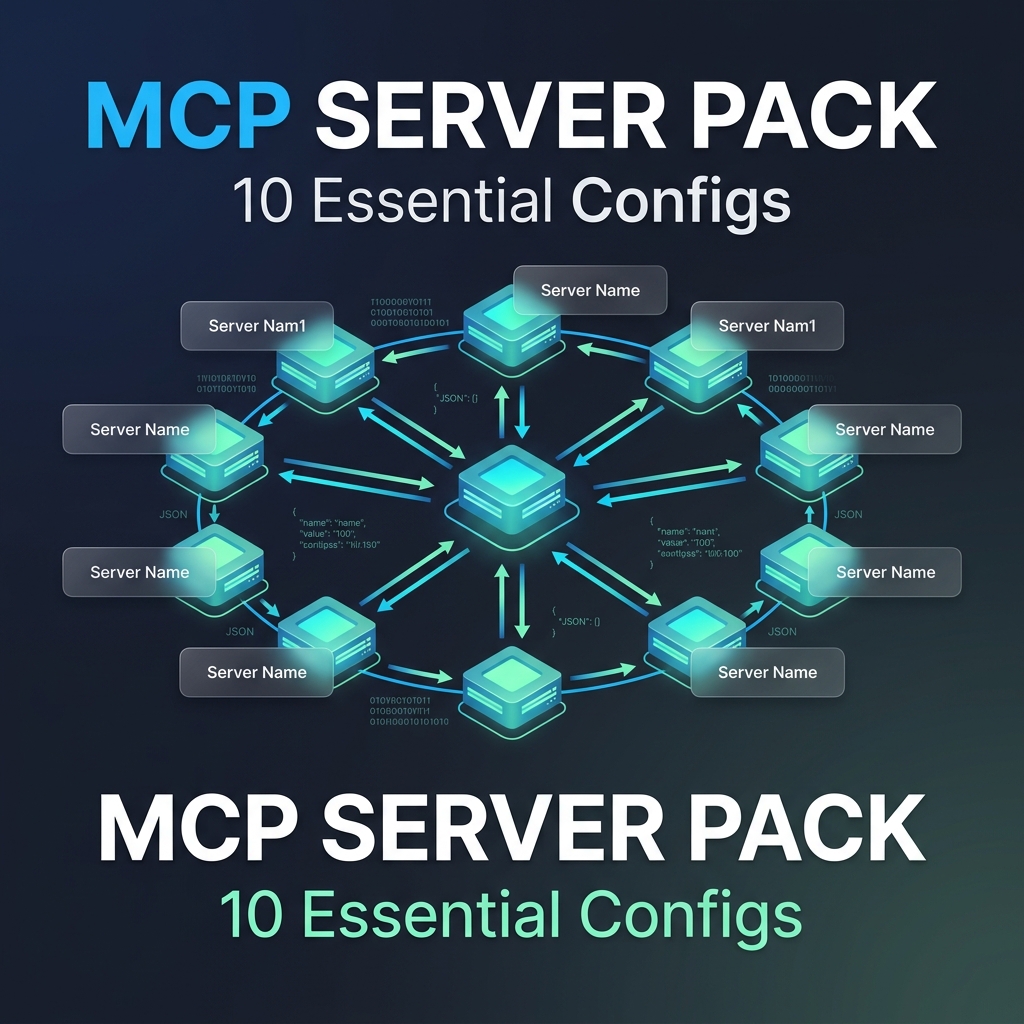
- Multi-Server Orchestration — Designs architecture for {{server_count}} MCP servers with service discovery, load balancing, and cross-server tool composition.
Each Prompt Includes
- {{placeholder}} variables for service type, transport protocol, language, and deployment target
- Expected output: MCP server code, configuration files, test suites, or architecture diagrams
- Chain-of-thought protocol design following official MCP specification
- Anti-patterns: god-tool design, missing error handling, and insecure input processing
Who This Is For
- Developers building MCP servers for Claude, ChatGPT, or other AI agents
- Platform engineers creating internal MCP infrastructure
- Tool builders who want to make their services AI-accessible
- AI agent developers designing tool ecosystems for autonomous workflows
What Makes This Different
- The ONLY comprehensive MCP server development resource — most guides cover basics only
- Production-grade: covers security, testing, deployment, and monitoring — not just "hello world"
- Written by developers who have built and deployed real MCP servers in production
Works With
Claude (native MCP support), ChatGPT (via MCP bridges), Gemini (via adapters). Best with Claude Code for MCP development.