
We tested the best AI agent starter kits of 2026. Compare templates, prompt vaults, MCP server packs, and full agent team playbooks. Ship your first agent in un
If you have spent a weekend following an AI agent tutorial only to end up with a toy demo and no path to production, you are the exact buyer this guide is written for. The gap between “my agent replied once” and “my agent runs reliably on real work” is wider than any tutorial admits. Starter kits close that gap. They bundle the system prompts, orchestration code, MCP server configs, and deployment playbooks that turn a 60-minute copy-paste exercise into an actual working agent you can point at real tasks the same day. After testing the kits we ship on wowhow.cloud and benchmarking them against the time it would take to rebuild each from scratch, the verdict is clear: the right starter kit saves 40 to 80 hours of engineering time per agent you want to ship. This guide walks through the five we recommend, who each one is for, and how to pick the one that matches your situation.
Try it yourself: Free AI Prompt Cost Calculator — free, no signup, runs in your browser.
What to Look For in an AI Agent Starter Kit (2026 Edition)
Before comparing specific kits, it is worth being explicit about what a useful starter kit actually contains. After testing dozens of free templates and paid bundles across 2025 and early 2026, the kits that actually save time share five characteristics. The kits that do not save time are missing at least one of them.
- Real system prompts, not placeholders. A working agent depends on a well-written system prompt. A starter kit that ships a one-line prompt like “You are a helpful research agent” is worse than useless — it forces you to do the actual hard work yourself. Good kits ship 200 to 400-word production prompts that encode specific role, tools, constraints, failure modes, and output format.
- Runnable orchestration code. If the kit claims multi-agent support, the code should actually run. That means working CrewAI crew definitions or LangGraph state graphs, not pseudocode. The gap between “example code” and “code you can copy into your repo and execute” is the entire value of a starter kit.
- Pre-configured MCP servers. The Model Context Protocol is how agents in 2026 talk to Gmail, Notion, GitHub, PostgreSQL, and hundreds of other real systems. A kit that ignores MCP forces you to write integration glue for every tool. A kit with pre-configured MCP server JSON for the common integrations saves a week per agent.
- A deployment playbook. Running an agent once on your laptop is the easy part. Running it on a Docker host, scheduled, monitored, with credential isolation is the hard part. A starter kit worth buying includes a deployment guide — Hostinger, DigitalOcean, or any Docker-capable VPS — not just code.
- Clean distribution format. The kit arrives as a zip with a clear directory structure, a real README with install steps, and no lorem ipsum. Sounds obvious, but we have downloaded “starter kits” from other marketplaces that were literally screenshots of code.
Every kit in the comparison below meets all five criteria. That is the reason these are the ones we ship and recommend — the market is full of kits that fail on at least one of these points, and we spent real time filtering them out.
The 5 AI Agent Starter Kits We Recommend in 2026
Here is the honest comparison. Each kit targets a different starting point — from “I have never built an agent” through “I want to run an entire autonomous business on agent infrastructure.” Pick based on where you are now, not where you want to be in six months.
1. AI Agent Starter Kit Bundle — $19 (Best for First-Time Builders)
What you get: Five complete agent templates — Research Agent, Email Agent, Content Agent, Data Scraper Agent, and Social Media Agent. Each template is a fully runnable CrewAI Python file with a matching 250-word system prompt, an n8n workflow JSON export you can import into any n8n instance, and a tool-configs file. A 10-minute README walks you through the install.
When to pick this: You have never shipped a working agent, or you have built one and want four more without rewriting boilerplate. The five templates cover the single most common agent use cases we see developers ask about: automated research, inbox triage, content drafting, targeted scraping, and social posting. You get all five for less than the cost of one hour of engineering time.
What it is not: This kit is not a full multi-agent orchestration system. Each template runs as a single agent. If you want agents that coordinate and hand off to each other, pick one of the two orchestration kits below.
Available at /product/ai-agent-starter-kit-bundle.
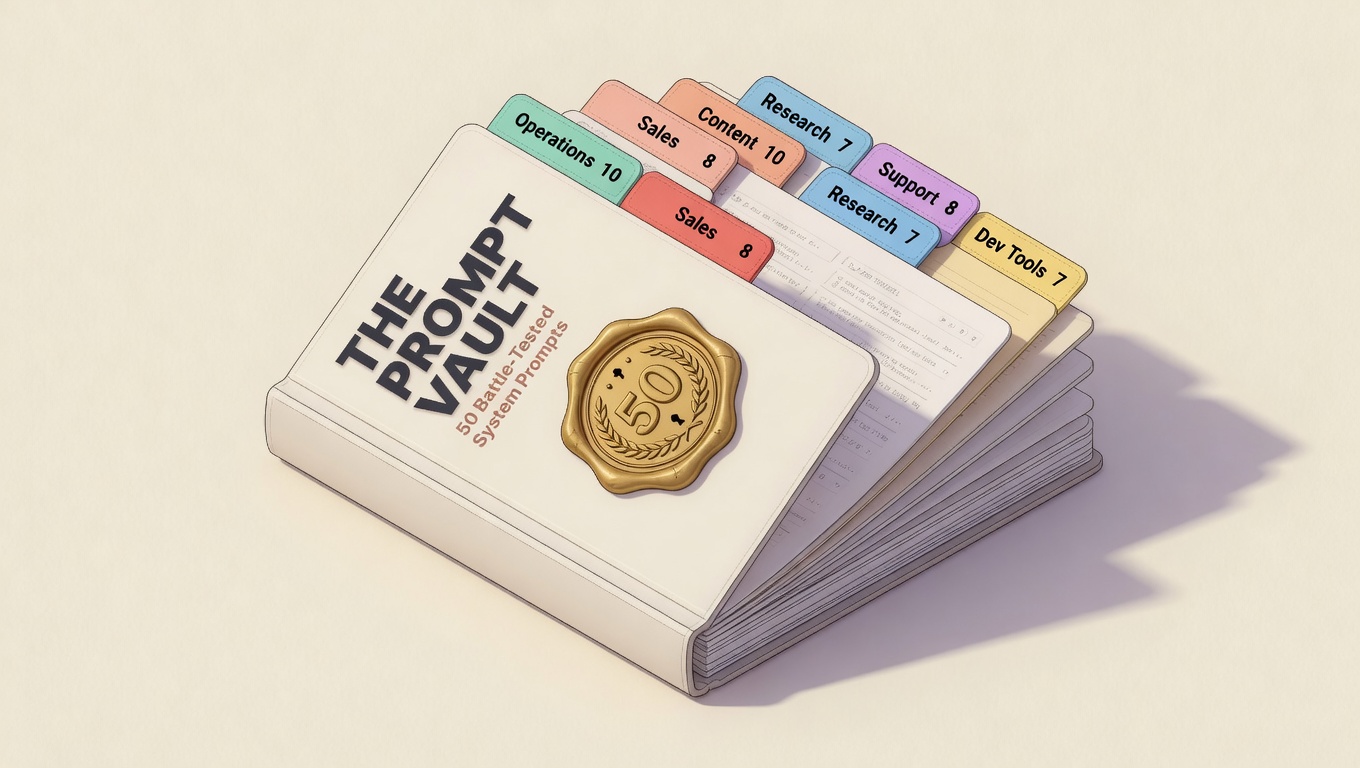
2. Agent Prompt Vault — 50 Production Prompts for AI Agents — $24 (Best for Prompt Engineers)
What you get: Fifty battle-tested system prompts organized into six use-case categories: Operations (10 prompts), Sales (8), Content (10), Research (7), Customer Support (8), and Developer Tools (7). Each prompt is a full 200 to 400-word production specification, annotated with a recommended model (Sonnet 4.6 for most, Opus 4.6 for the research and strategy prompts), the expected output format, and an estimated cost per run.
When to pick this: You have the infrastructure. You can already run agents. What you are missing is the prompts. Or you are writing agents for clients and want a reference library of known-good prompts you can adapt rather than start from a blank page. This is the kit you buy on your second agent, not your first.
What it is not: This is a prompt library, not an orchestration kit or code template. You are expected to have the Python or TypeScript skeleton already. If you do not, pair it with one of the code-first kits below.
Available at /product/agent-prompt-vault-50-production-prompts-for-ai-agents.
3. MCP Server Pack — 10 Essential Configs for Claude Code — $14 (Best for MCP Integration Speed)
What you get: Pre-configured MCP server setups for the ten most-integrated services of 2026: Gmail, Google Calendar, Notion, Slack, GitHub, PostgreSQL, Google Drive, Airtable, Discord, and Twitter/X. Each config includes a valid mcpServers JSON block compatible with Claude Code, Cursor, and Claude Desktop, plus an auth setup guide, a security-hardening note, and a test prompt you can paste in to verify the connection works.
When to pick this: You are tired of reading a different “how to set up MCP for <service>” blog post every time you add a new integration. You want the config, you want the security notes, and you want to move on. The pack pays for itself the first time you avoid a three-hour auth debugging session on Google APIs.
What it is not: This is not a tutorial on what MCP is. It assumes you already know that MCP lets agents call tools, and you just want the configs. For a full introduction to MCP itself, our Claude Managed Agents guide covers the fundamentals.
Available at /product/mcp-server-pack-10-essential-configs.
4. Agent Team Playbook — Content Empire 5-Agent System — $39 (Best for Content Ops)
What you get: A full five-agent orchestrated pipeline: Researcher → Writer → Editor → SEO Optimizer → Publisher. The kit ships the complete CrewAI Crew definition and a LangGraph StateGraph with conditional edges, both wired with model routing (Groq for fast research, Claude Sonnet for writing, Claude Opus only for the editor’s final pass where it matters). Four MCP server configs ship with it — Notion, WordPress, Medium, and Buffer — along with a Dockerfile, docker-compose.yml, and a deployment guide aimed at a $5/mo Hostinger VPS.
When to pick this: You are the solo content operator, freelance writer, or small agency owner who wants the content-production pipeline of a ten-person team. The playbook is not a generic agent framework; it is specifically a content production system, end-to-end, with opinionated choices about where each agent hands off to the next.
What it is not: It is not a general-purpose agent framework. If you want to build anything other than content pipelines, pick one of the other kits.
Available at /product/agent-team-playbook-content-empire.
5. Autonomous Business Bundle — 7-Agent Business Operation Stack — $79 (Flagship)
What you get: The flagship of the lineup. Seven coordinated agents that cover the operational backbone of a small business: Inbox Agent, Calendar Agent, Project Manager Agent, a three-agent Content Team, and a Revenue Scout Agent. The orchestration layer is a LangGraph main graph with a TypedDict State schema and conditional routing between all seven agents. An n8n workflow export ships alongside the Python code so you can run the same pipeline in either environment. A 30-day deployment playbook walks through Week 1 (Deploy), Week 2 (Monitor), Week 3 (Optimize), and Week 4 (Scale). Includes a CLAUDE.md template for integration with Claude Code.
When to pick this: You want to run your business on agent infrastructure, not just one task. The bundle is intentionally the most expensive in the lineup because it is the most complete. It replaces what would otherwise be four or five separate kits plus a week of integration work.
What it is not: It is not a beginner kit. If you have never deployed a Docker container or read a LangGraph graph definition, start with kit #1 and work up.
Available at /product/autonomous-business-bundle.
Side-by-Side Comparison Table
Here is the short version for buyers who want to pick in under a minute:
| Kit | Price | Best For | Agent Count | Orchestration | MCP Configs |
|---|---|---|---|---|---|
| AI Agent Starter Kit Bundle | $19 | First-time builders | 5 standalone | None (single-agent) | Per-template |
| Agent Prompt Vault | $24 | Prompt engineers | 50 prompts | N/A | N/A |
| MCP Server Pack | $14 | Integration speed | N/A | N/A | 10 services |
| Agent Team Playbook | $39 | Content pipelines | 5 coordinated | CrewAI + LangGraph | 4 services |
| Autonomous Business Bundle | $79 | Full business stack | 7 coordinated | LangGraph + n8n | Multi |
How to Pick the Right Kit (Decision Framework)
If you only read one section, make it this one. Match the starter kit to the exact problem you are trying to solve today — not the problem you think you will have in six months.
- Never built an agent before? Start with the AI Agent Starter Kit Bundle. Five templates for $19 is the cheapest possible way to get five agents running. Ship one, see it work, then decide what to build next.
- Have the code but need better prompts? The Agent Prompt Vault is your kit. Fifty production prompts across six categories means you stop writing prompts from scratch and start iterating on prompts that already work.
- Stuck setting up MCP servers? Buy the MCP Server Pack and move on. Fourteen dollars for ten working configs is strictly cheaper than debugging Google OAuth for two hours.
- Running a content operation? The Agent Team Playbook is opinionated for your exact use case. Do not build this yourself.
- Want the whole stack? The Autonomous Business Bundle is the complete answer — seven agents, full orchestration, 30-day playbook. This is the kit you pick when you are ready to treat agents as infrastructure, not experiments.
Common Mistakes When Buying a Starter Kit
Based on the questions we get from buyers and the patterns we see on developer forums, here are the four mistakes to avoid.
Mistake 1: Buying the flagship before you have shipped one agent. The Autonomous Business Bundle is the most expensive kit for a reason — it assumes you can read a LangGraph graph and deploy a Docker container. If you have not done that yet, start with the $19 starter kit and work up. You will save money and you will actually understand what you are running.
Mistake 2: Buying a prompt vault when you needed orchestration code. Prompt libraries are maximally useful once you have the runtime. Before that, they sit in a folder. Check that you have a skeleton first — if not, pick one of the code-first kits.
Mistake 3: Skipping the MCP pack and writing integrations by hand. Every developer we watched skip the MCP pack eventually came back and bought it after their third OAuth debugging session. At $14 this is the single highest ROI purchase in the lineup.
Mistake 4: Thinking you need all five kits. You do not. Pick the one that matches your current situation. If you genuinely need more later, come back then. Nothing in the catalog is going anywhere.
Why Starter Kits Beat Building From Scratch in 2026
A legitimate question: is buying a $19 starter kit really faster than writing the code yourself? For a working solo developer, the answer is yes — by a large margin. Writing a single production-grade agent from scratch takes four to eight hours even for someone experienced: writing the system prompt, picking tools, setting up the CrewAI or LangGraph skeleton, wiring the MCP servers, writing the deployment config. Five such agents is a week. The starter kit is a decision about whether your engineering hours are worth more than $4 each. If they are, the math is settled.
The second reason is harder to measure but more important: starter kits encode the failure modes that you would otherwise discover the painful way. Every working prompt in the vault was iterated until it handled the edge cases. Every CrewAI crew definition was tested until the handoffs worked. You are paying for the time someone else already spent breaking things, not just for the files.
Next Steps
Once you have picked a kit, the workflow we recommend for shipping your first agent is the same regardless of which kit you start with:
- Download the zip and unpack it into a fresh folder — keep it out of existing projects until you understand it.
- Follow the kit’s README word-for-word the first time. Skip nothing. Deviations come later.
- Run the test prompt or sample invocation exactly as documented. Verify it works before modifying anything.
- Change one thing. See what happens. Change a second thing. See what happens. Small iterations, not rewrites.
- Ingest your learnings into your own notes — we use an Obsidian vault for this. Future you will thank current you.
If you want more context on how production-grade agent infrastructure works under the hood — sandboxing, session persistence, credential isolation — read our Claude Managed Agents guide. If you are ready to browse the full agent product catalog, start at /browse or explore the free tools that ship alongside the paid kits.
Whichever kit you pick, the goal is the same: stop rebuilding agent boilerplate and start shipping the work only you can do. That is the entire point of a starter kit, and in 2026 the tools are finally good enough that buying one is the obviously correct call.
Related reading
Written by
WOWHOW
The WOWHOW team brings 14+ years of production engineering experience. Every tool and product in the catalog is built, tested, and curated in-house.
Monday memo · free
One insight, every Monday. 7am IST.
1 field report, 3 links, 1 tool we actually use. No fluff, no spam.
Beyond the writing
Need production-ready templates?
Free browser tools with no signup, plus premium dev templates and starter kits.


Comments · 0
Beta: comments are stored locally on your device and not visible to other readers.
No comments yet. Be the first to share your thoughts.